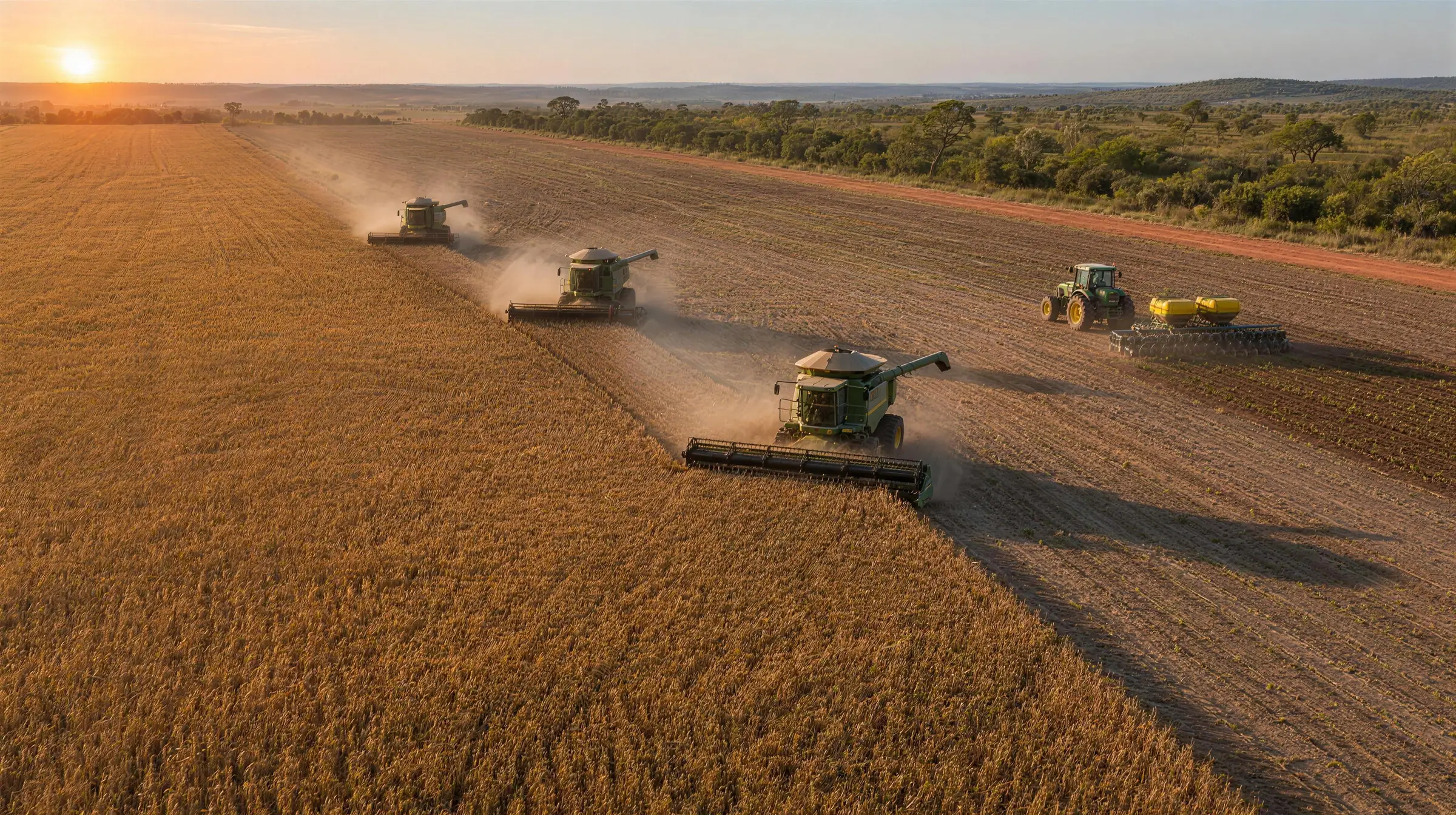
Brazilians have heard that agribusiness is in the spotlight and accounts for a substantial share of the country’s GDP and foreign exchange earnings. After all, “agro is pop,” as Globo’s advertising campaign puts it—but why? What will enable Brazil to strengthen its global leadership in this sector over the next ten years, potentially creating the opportunity of the decade? Below, I outline ten reasons why this could happen—or, more precisely, ten reasons to start paying attention to this sector.
First reason
Global food demand will continue to grow—and the opportunity extends beyond China, our main trading partner in this sector.
The OECD–FAO Agricultural Outlook 2025–2034 projects a 13% increase in global consumption of agricultural and fish products, primarily in low- and middle-income countries. The prevailing view is that Brazil could serve multiple expanding markets, diversifying its customer base. However, the need for supplies does not necessarily translate into purchasing power. The regions facing the greatest food shortages are not necessarily the wealthiest, but the 13% figure gives some indication of how much additional output the world will need to bridge this gap.
Second reason
Brazil has the scale to capture a substantial share of this global growth.
One projection suggests that Brazil will account for 61% of global soybean exports in 2035. An important distinction must be made here: this refers to Brazil’s share of exports, rather than global production. We may not be the world’s largest producers, but our prominence in generating exportable surpluses is undeniable because we produce more than we consume. This positive balance gives Brazil a leading role and could drive activity throughout the value chain: origination, processing, transportation, storage and financing.
Third reason
There is substantial scope to expand domestic production by restoring previously cleared land, without the need for further deforestation.
An Embrapa assessment identified approximately 28 million hectares of degraded pastureland with good or very good agricultural potential. Converting these areas could support an expansion equivalent to as much as 35% of the land planted with grains in the 2022/23 reference crop year.
Fourth reason
Two harvests per year—and, under certain conditions, as many as three—make it possible to produce more from the same land.
The argument goes beyond the availability of land, which Brazil has in abundance. This agricultural powerhouse can also increase the intensity of land use throughout the year through its favorable climate, improved soils and irrigated acreage. Successive crops on the same land increase total annual output while improving fixed-capital utilization and spreading production, machinery and infrastructure costs across greater volumes. The feasibility varies by region, crop and climatic conditions, but the upside is substantial.
Fifth reason
Technology developed for tropical agriculture has already demonstrated its ability to multiply domestic output.
Between 1975 and 2020, Brazil’s agricultural and livestock output grew by approximately 405%, while input use increased by 33% and total factor productivity rose by 278%. The point is that Brazil’s growth has not come solely from expanding cultivated land: it has also involved a genuine leap in efficiency. Although past performance does not guarantee future results, this progress has already placed us at the technological forefront of the sector, ahead of numerous competitors.
Sixth reason
Rising animal protein consumption amplifies grain demand and stimulates production.
Daily per capita calorie intake from animal-source foods is projected to increase by 6% in middle-income countries. Higher consumption of meat, milk and eggs generates additional demand for animal feed, corn, soybean meal, processing and logistics. Brazil’s opportunity therefore includes both exporting animal protein and supplying the world with the grains needed to produce it.
Seventh reason
Corn now connects three markets: food, animal feed and energy.
Brazil produced 7.55 billion liters of corn ethanol in 2024, accounting for approximately 20% of the country’s total ethanol production. This new industry, which uses the latest “4.0” generation of U.S. corn ethanol technology rather than Brazil’s homegrown sugarcane ethanol technology, has created substantial additional demand in record time. It has also stimulated industrial development through plants located close to grain origination areas. In turn, the strong domestic demand generated by these massive industrial facilities has encouraged further expansion of local production around them.
Eighth reason
Improvements in export corridors can translate production capacity into international competitiveness.
The Northern Arc’s share of soybean, corn and cotton exports increased from 20% in 2015 to 35% in 2025, with volumes rising from nearly 20 million to almost 60 million metric tons. Significant potential also remains in rail and lake-based transportation. The logic is straightforward: reducing the cost of delivering products to buyers makes Brazilian production more competitive.
Ninth reason
Even Brazil’s infrastructure bottlenecks create new business and investment opportunities.
According to an IBGE survey, Brazil had 233.8 million metric tons of usable storage capacity in 2025. Opportunities encompass grain storage, drying and handling. The caveat is that any shortfall must be assessed by region, crop and seasonal calendar: simply subtracting static storage capacity from annual production does not adequately measure actual requirements. Nevertheless, these infrastructure gaps open the door to further investment across these segments of agribusiness.
Tenth reason
Capital markets are expanding the options for financing this growth.
Recently cited figures of R$600.3 billion in Rural Product Notes (CPRs) and R$174.95 billion in Agribusiness Receivables Certificates (CRAs) in August 2026, together with R$65.78 billion in net assets across 291 agribusiness investment funds (FIAGROs) in July 2026, illustrate the breadth of opportunities in credit, structuring, collateral and risk management. They also demonstrate the scale of agricultural production financing in Brazil and its remaining growth potential.
These ten reasons converge on a macro investment thesis: Brazil is well positioned to translate expanding global demand into a new cycle of production, industrial development and value creation. Every productivity gain drives activity across an entire value chain. Every bottleneck overcome creates room for new businesses. Tauri Agrícola’s investment thesis gains strength from the combination of the scale Brazil has already achieved and the potential it has yet to develop: a large existing market, growing global demand and room for companies capable of turning that potential into results.
Over the next decade, the world will need more food, protein and energy. Meeting that demand will require capital, infrastructure, technology and the ability to connect production with consumer markets. Those who finance, organize and accelerate this expansion will have the opportunity to capture value well beyond the farm gate.
For foreign investors, participating in this cycle requires a local presence, market intelligence, governance and partners capable of disciplined execution and risk management. Brazil’s potential puts it on the investment radar. Choosing the sector opens the opportunity. But the quality of execution determines what can be built on that foundation. And choosing whom to build with may be the most important decision along the way.
Alexandre de AzambujaFounder & CVO